Remodeling in La Crescenta and Montrose: What to Know
The first question in La Crescenta or Montrose is not what you want to build, it is which government you answer to. Glendale annexed the Crescenta Valley one neighborhood at a time between 1951 and 1955 rather than all at once, so the city line zigzags through the community block by block. One house is City of Glendale, with Glendale's counter and Glendale Water and Power. The house across the street may be unincorporated Los Angeles County, permitted through County Building and Safety and County Regional Planning, with water and sewer from Crescenta Valley Water District and electricity from Southern California Edison. Two other facts shape almost every project here. Los Angeles County adopted the West San Gabriel Valley Area Plan on March 11, 2025, and its Title 22 zoning amendments took effect April 11, 2025. And the local sewer system was not built until 1979 to the mid 1980s, so most homes in the community are older than the pipe they now drain into.
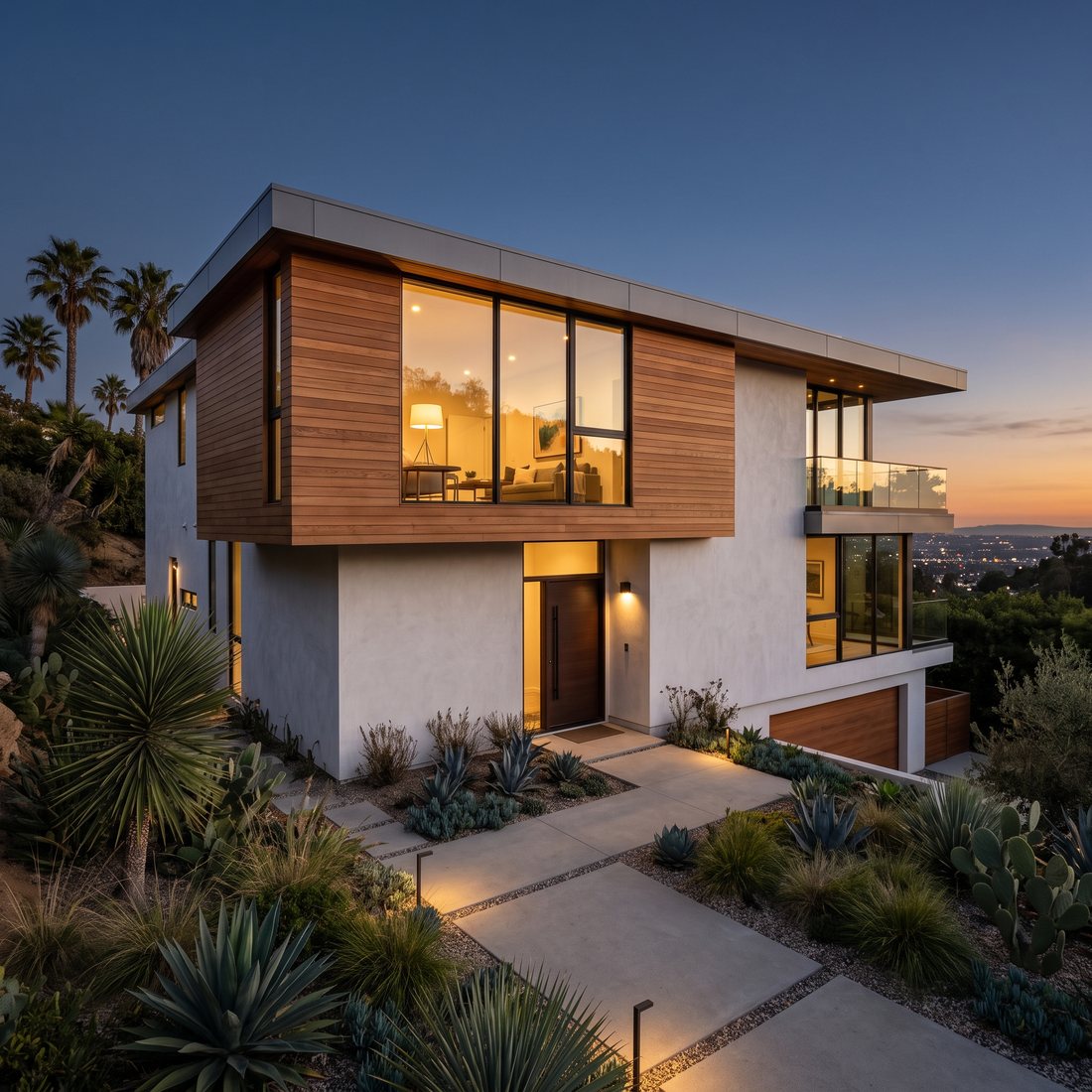
There is no such thing as a general answer about building in the Crescenta Valley, because there is no single Crescenta Valley government. The community is a patchwork, and the seam runs down the middle of ordinary residential blocks.
That is not an accident of geography. When Glendale wanted the foothills in the early 1950s, residents voted heavily against being annexed as a whole. So the city canvassed the area block by block from 1951 to 1955 and annexed it a neighborhood at a time. Some blocks said yes. Some said no. Seventy years later the line still bends around the ones that said no.
For a homeowner, that history has an immediate price tag. Get the jurisdiction wrong and you have paid an architect to draw to the wrong code, submitted to a counter that will not take your package, and started a project with the wrong utility on the phone.
Step one is finding out who you answer to
La Crescenta-Montrose, as the County defines it, is a census-designated place of about 3.45 square miles covering the parts of the Crescenta Valley that are not inside the cities of Glendale or La Cañada Flintridge. Glendale wraps it on the south and west. La Cañada Flintridge sits to the east. The Angeles National Forest closes the north.
Honolulu Avenue, including the Montrose Shopping Park, is inside the City of Glendale. Foothill Boulevard, north of the 210, runs through unincorporated County territory. Between and around them the boundary is genuinely irregular.
If your parcel is unincorporated:
- Zoning and land use go to the LA County Department of Regional Planning, (213) 974-6411, under Title 22 of the County code.
- Building permits and inspections go through County Public Works Building and Safety and the EPIC-LA online permit system. The Crescenta Valley Chamber of Commerce sends unincorporated La Crescenta permit traffic to 125 S. Baldwin Ave. in Arcadia, (626) 574-0941, with plan check and MEP review at 900 S. Fremont Ave. in Alhambra. Confirm your serving office by address at permits.lacounty.gov, since County district assignments do move.
- Fire review is Los Angeles County Fire, on its own track.
If your parcel is inside Glendale, all of that is irrelevant and you are at the city counter instead, on Glendale's fee schedule and Glendale's plan check queue. We compared those queues in permits in Glendale vs Burbank vs Los Angeles; the point here is that in this one community you cannot assume which of them you are in.
The same split runs through the utilities. Crescenta Valley Water District supplies water and sewer service to the unincorporated communities of La Crescenta, Montrose and Verdugo City, plus a small slice of La Cañada Flintridge. Glendale Water and Power serves the Glendale side. Electricity in the unincorporated area is largely Southern California Edison rather than GWP. That distinction is not trivia. It decides who de-energizes your service for a panel swap, what the rebate landscape looks like, and how long the meter release takes, all of which we broke down in electrical panel upgrades in LA, Burbank and Glendale.
The buried surprise almost nobody budgets for
Here is the fact that separates an experienced local contractor from a bidder driving in from the Westside.
The Crescenta Valley did not get public sewers until recently, in housing-stock terms. Crescenta Valley Water District became concerned in the 1970s about private wastewater systems affecting local groundwater, formed two sewer assessment districts in 1979 using Clean Water Act funding, and built roughly 64 miles of mainline sewer and 27 miles of house-connection laterals, finishing in the mid 1980s.
Now set that against the housing data. LA County Planning counts 7,375 housing units in the community, 76.5 percent of them single-family, and 83 percent built before 1979 — well above the countywide average of 72.7 percent. Fewer than one percent were built after 2010.
Put plainly: the overwhelming majority of houses in La Crescenta and Montrose were built to drain into a septic tank or seepage pit, and were connected to the sewer decades after construction. Those tanks were supposed to be pumped, crushed and backfilled. Not all of them were, and the paperwork from forty years ago is often gone.
That matters the moment you dig. An ADU slab, a pool, a garage-conversion footing, a new addition, a deepened foundation, even a large tree removal can find a void, a partially filled tank, or a lateral routed nowhere near where the drawings assume. The cost of finding out early is a locate and a camera run. The cost of finding out late is a stopped job, an unplanned engineering letter and a soils fix.
Ask two questions before you sign anything: where did the original waste line run, and is there any record of the tank being properly abandoned.
The zoning moved in 2025
Most content about this area is out of date, because the rules changed last spring.
The Board of Supervisors adopted the West San Gabriel Valley Area Plan on March 11, 2025, covering nine unincorporated communities including La Crescenta-Montrose, and the accompanying Title 22 amendments took effect April 11, 2025. Across those nine communities the plan anticipates roughly 10,874 new housing units over about twenty years.
For this community specifically, the plan pushes growth toward Foothill Boulevard and encourages missing-middle housing — townhouses, duplexes, triplexes — near Foothill Boulevard, Montrose Avenue and Honolulu Avenue. Individual parcels were rezoned, including commercial frontage where Foothill Boulevard turns into Cloud Avenue, and a parcel near Ocean View and Foothill that moved from nine to thirty dwelling units per net acre.
Layered on top of the base zoning is the La Crescenta-Montrose Community Standards District, Chapter 22.328 of Title 22, established in 2020. It is not a single-family rulebook — it applies to the R-3 residential zones and the commercial zones along Foothill Boulevard — but if you own income property or a mixed-use building here, it governs façade treatment, materials and landscaping, and it caps height at 35 feet where average lot depth is 100 feet or less.
Practical takeaway for a single-family owner: your parcel's designation may not be what it was two years ago, and the answer is worth pulling fresh from County Planning rather than from a listing sheet.
Fire and water, in that order
The north edge of the community runs directly into the San Gabriel Mountains. CAL FIRE released updated fire hazard severity zone maps for this region in March 2025, with the County Board given 120 days to review and recommend. Where a parcel carries a very high designation, Chapter 7A of the building code applies to new construction and, in most jurisdictions, to substantial exterior alterations — Class A roofing, ember-resistant venting, ignition-resistant siding and decking, rated glazing. We priced that work out in what Chapter 7A fire hardening costs. It is not a small line item, and it is not optional once the map says so.
Water is the older story and it still shapes the ground you build on. On New Year's Day 1934, earthen dams above the valley failed and sent mud and debris through La Crescenta and Montrose. Forty-nine people died. One hundred ninety-eight homes were destroyed and roughly four hundred more were left uninhabitable. Parts of Foothill Boulevard were buried under twelve feet of mud and boulders. Construction of debris basins and concrete conduits began that same year, and the network was substantially complete by 1938.
Those basins are why the valley is habitable, and they are also why drainage and grading review here has teeth. On a sloped lot, retaining work, hardscape and any change to where water leaves your property deserve engineering attention early rather than a redline late. The neighboring city handles its foothill parcels with an explicit hillside permit, which we covered in remodeling in La Cañada Flintridge — the County's approach differs in form, not in seriousness.
What the houses themselves are like
Eighty-three percent pre-1979 stock, in a foothill community, means a predictable systems list behind the finishes: undersized electrical service, galvanized supply lines, minimal or no wall insulation, unbolted mudsills on the older prewar homes, and clay or cast-iron drain lines running out to a sewer that was not there when the house was framed.
The order of operations that works here is the same one that works in any pre-1980 Valley house. Open the walls, price the systems, then decide what the finish budget can be. Doing it the other way around is how a kitchen becomes a whole-house project halfway through, and it is the failure mode we designed our whole-home renovation process to prevent.
None of the numbers above are quotes. Cost ranges in this market vary with access, slope, and what the last owner did without a permit. But the jurisdiction question, the septic question, and the fire zone question all have exact answers for your specific address, and all three are free to find out.
Start there.
Questions
Is La Crescenta part of Glendale?
Partly, and that is the problem. La Crescenta-Montrose is a census-designated place of about 3.45 square miles that covers the parts of the Crescenta Valley not inside the cities of Glendale or La Cañada Flintridge. Glendale annexed the area neighborhood by neighborhood in the early 1950s instead of in one vote, which is why the boundary wanders mid-block. Honolulu Avenue and the Montrose Shopping Park sit inside Glendale. Much of the residential grid north of it does not. Confirm your parcel before you hire anyone, because the answer changes your permit path, your fees and your utility accounts.
Who issues building permits in unincorporated La Crescenta?
Los Angeles County. Zoning and land use questions go to the Department of Regional Planning at (213) 974-6411, and building permits and inspections run through County Public Works Building and Safety and the EPIC-LA online system. The Crescenta Valley Chamber of Commerce directs unincorporated La Crescenta permit questions to the district office at 125 S. Baldwin Ave. in Arcadia, (626) 574-0941, with plan check and mechanical, electrical and plumbing review at 900 S. Fremont Ave. in Alhambra. Verify your serving office by address at permits.lacounty.gov before you drive anywhere. If your parcel turns out to be inside Glendale, none of that applies and you go to the city instead.
Do homes in La Crescenta have septic tanks?
Many did, and some of those tanks are still in the ground. Crescenta Valley Water District formed two sewer assessment districts in 1979 and finished building roughly 64 miles of mainline sewer and 27 miles of house-connection laterals by the mid 1980s. About 83 percent of the community's housing stock predates 1979, which means the typical house here was built with private wastewater disposal and connected to the public sewer later. An abandoned tank or seepage pit is a real risk on any project that touches the yard, including an ADU pad, a pool, a garage conversion or an addition footing. Find out where it is before you price the excavation, not after the backhoe drops into it.
What changed in the zoning here in 2025?
The Board of Supervisors adopted the West San Gabriel Valley Area Plan on March 11, 2025, and the accompanying Title 22 zoning amendments took effect on April 11, 2025. For La Crescenta-Montrose the plan concentrates future growth along Foothill Boulevard and encourages missing-middle housing types such as townhouses, duplexes and triplexes near Foothill Boulevard, Montrose Avenue and Honolulu Avenue. Several parcels were rezoned outright, including commercial land near where Foothill Boulevard becomes Cloud Avenue. If you last checked your zoning designation before spring 2025, check it again.
Is my property in a fire hazard severity zone?
Quite possibly. The northern boundary of the community abuts the San Gabriel Mountains and Angeles National Forest for most of its length, and CAL FIRE released updated hazard zone maps for this part of Southern California in March 2025, with the County Board of Supervisors given 120 days to review and comment. A very high designation pulls new construction and substantial exterior work into Chapter 7A of the building code, which governs roofing, vents, siding, glazing and decking. Look your address up on the state map rather than assuming the answer from a neighbor.