Remodeling in Woodland Hills — What to Know
Woodland Hills remodels run through LADBS like the rest of the City of LA — the Van Nuys office at 6262 Van Nuys Blvd serves the Valley — but three local factors change projects here. It is the hottest official microclimate in LA County (121°F recorded at Pierce College in September 2020), so cooling, insulation, and duct work deserve budget priority. Its signature mature trees include protected native species you cannot touch without an Urban Forestry permit. And lots south of Ventura Blvd climb into the Santa Monica Mountains, triggering the Baseline Hillside Ordinance.
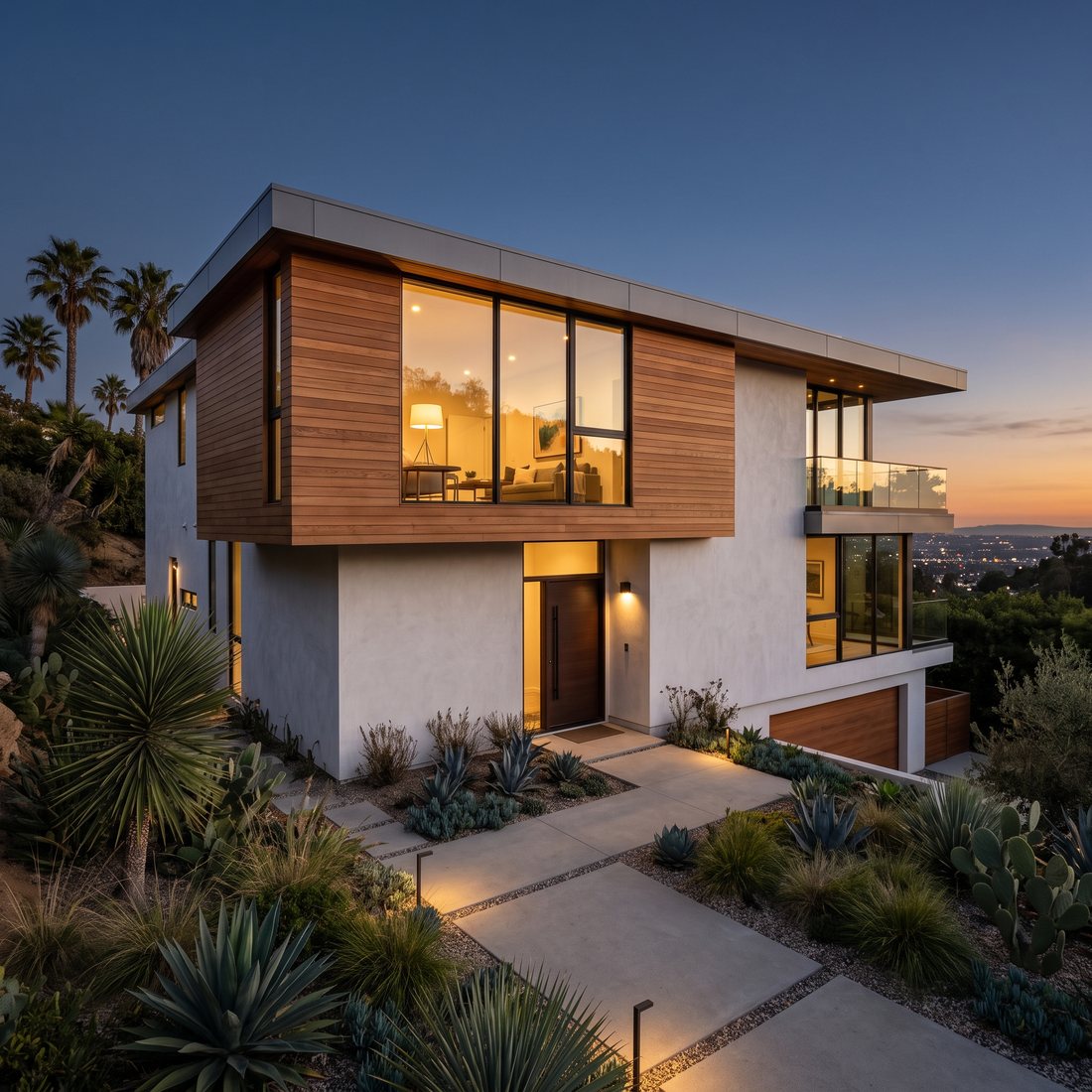
Woodland Hills was planted before it was built. Real-estate promoter Victor Girard founded the town site in 1922 and put tens of thousands of trees in the ground to sell lots — pepper trees along the boulevards, eucalyptus and oaks across the hills. The name changed to Woodland Hills in 1945, but the canopy stayed, and it still defines what remodeling here means: mature trees with legal protection, a hot inland microclimate under that canopy, and a housing stock that runs from 1920s Girard-era cottages to postwar ranch tracts to 1960s–70s hillside customs.
Here is what changes when the project is in Woodland Hills.
The hottest official address in LA County
On September 6, 2020, the weather station at Pierce College recorded 121°F — the highest temperature ever measured at an official station in Los Angeles County. That was a record day, but the pattern behind it is ordinary: the West Valley routinely runs 10–15 degrees hotter than coastal LA all summer.
For remodel planning, that flips the usual priority list. In much of LA, cooling is a comfort line item; in Woodland Hills it is infrastructure. If the house still runs on a wall furnace and window units — common in the postwar tracts — budget for adding central air as part of any major remodel, and treat the duct design and attic insulation as seriously as the finishes. Title 24 requires ducts insulated to R-6 and verified duct sealing anyway; here the energy code and your July electric bill are pushing in the same direction. One knock-on effect worth checking early: AC condensers are exactly the kind of load that forces a 100-amp panel up to 200 amps, so get the panel assessed before the HVAC bid, not after.
The trees are not decoration — they are regulated
Those Girard-era plantings matured into a canopy that includes protected native species: all native oaks, western sycamore, California bay, and Southern California black walnut, plus elderberry and toyon shrubs. Under LA's protected tree ordinance, anything over 4 inches cumulative trunk diameter cannot be removed or relocated without an Urban Forestry Division permit, a certified tree expert's report, and 4-to-1 replacement planting.
This lands on remodels in two ways. First, site planning — an addition, a pool, or even trenching for utilities inside a protected tree's drip line can require protection measures or redesign. Second, enforcement — the city can withhold building permits on a lot for up to a decade after an illegal removal, which means a previous owner's chainsaw decision can become your permitting problem. If a protected tree sits anywhere near your planned footprint, resolve it in design, not in framing.
South of Ventura, the hillside rules kick in
Woodland Hills splits at Ventura Boulevard the way most of the south Valley does. North of the boulevard: mostly flat postwar tracts on conventional lots, straightforward R1 permitting. South of it, the lots climb into the Santa Monica Mountains, and remodels fall under the Baseline Hillside Ordinance — tighter height and grading standards, limits on cut-and-fill and exported dirt, and slope-based floor-area math. Foundations, drainage, and access all get more expensive with grade, a pattern we covered in what hillside lots actually cost. If you are comparing two Woodland Hills houses to buy and remodel, which side of the boulevard they sit on is a five-figure difference before the first wall opens.
Warner Center is its own animal
The high-rise core between the 101 and Vanowen runs under the Warner Center 2035 Specific Plan — the Valley's biggest concentration of new density. Single-family remodels outside that boundary are not governed by it, but the growth shapes the neighborhood around you: construction traffic on the boulevards, and steadily rising comps that keep pushing Woodland Hills remodel budgets — and returns — upward.
The practical checklist
Permits go through LADBS — the Van Nuys Development Services Center at 6262 Van Nuys Blvd serves the Valley. The housing stock carries the standard mid-century inventory behind its walls — galvanized supply pipe, 100-amp panels, minimal insulation (which matters more here than anywhere in the city). And if the project grows into a gut renovation, sequence it like any whole-home renovation: structure and systems first, cooling designed for this microclimate, finishes last. In Woodland Hills, the houses that hold value are the ones built for the heat — and around the trees.
Questions
Which trees are protected on Woodland Hills lots?
All native oaks (except scrub oak), western sycamore, California bay, and Southern California black walnut, plus Mexican elderberry and toyon shrubs — anything measuring 4 inches or more in cumulative trunk diameter. Removing or relocating one requires a permit from LA's Urban Forestry Division with a report from a certified tree expert, and replacement at a 4-to-1 ratio on the property. The penalty has real teeth — the city can withhold or revoke building permits on the lot for up to 10 years after an illegal removal.
Does the Warner Center 2035 plan affect single-family remodels?
Not directly. The Warner Center 2035 Specific Plan governs the high-rise core between the 101 and Vanowen — its density, height, and mobility rules apply to development inside that boundary, not to the R1 neighborhoods around it. What homeowners do feel is the growth itself, in traffic and in comps. A single-family remodel outside the plan area follows standard citywide R1 rules.
Do I need air conditioning sized differently in Woodland Hills?
Effectively yes. Load calculations are climate-based, and the West Valley sits in a hotter design condition than coastal LA — the same square footage that a 3-ton system handles in Santa Monica can need noticeably more capacity here. Right-sizing matters more than oversizing — an oversized unit short-cycles and dehumidifies poorly. Expect your contractor to run a Manual J calculation, and expect Title 24 duct sealing and insulation requirements to apply.